Blackened Salmon Over Zoodles
Blackened Salmon Over Zoodles
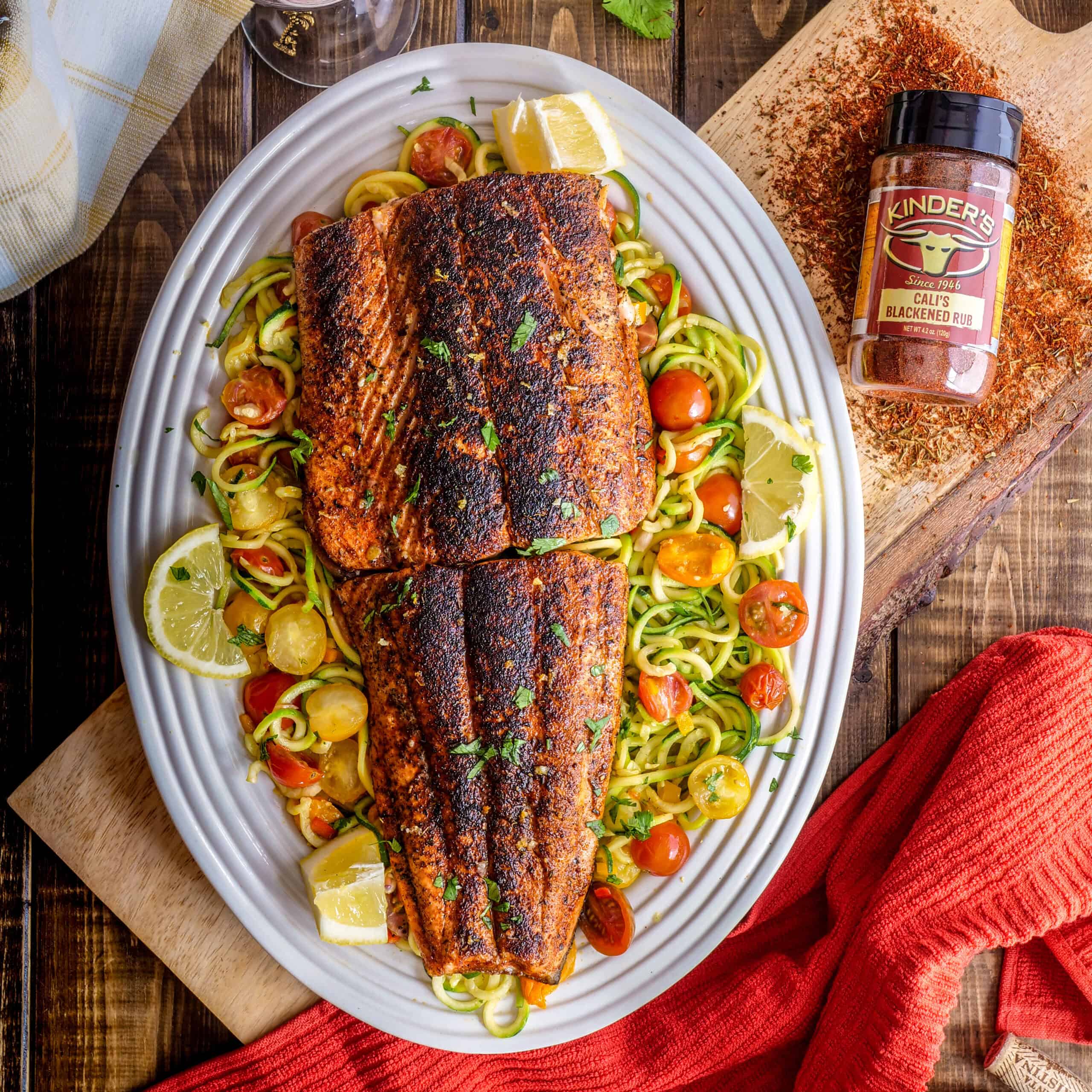
Start with the crust. That’s the whole point of a blackened salmon recipe, Kinder’s Cali Blackened Rub hitting a hot oiled skillet and forming a dark, smoky bark on the outside while the salmon stays moist in the center. Without the crust, you just have seasoned fish. Get the crust right, and you have something worth plating on a Tuesday night without a second thought.
Crust first, everything else after. That order governs a lot of our Kinder’s recipes.
This is pan-seared salmon over spiralized zucchini noodles with cherry tomatoes and sweet bell pepper. Ready in 35 minutes. The zoodles stay tender-crisp, the tomatoes burst, and a hard squeeze of lemon finishes everything clean. It holds up for meal prep too, store the salmon and zoodles separately and you have two solid lunches waiting.
Cali Blackened Rub brings the smoke and the savor, with a low heat that builds into something more. Pat the fillets dry before you coat them and press the rub in on both sides so it adheres. That step matters more than any other. Moisture is the enemy of crust.
Don’t touch the salmon once it goes in the pan. Let it sit. Four to five minutes on the first side builds the dark bark you’re after, you’ll see the edges turn opaque as it cooks up from the bottom. Flip once, bring it to 145°F, and pull it to a plate. Tent it loosely with foil while you finish the zoodles.
Add the zoodles last, for the shortest time possible. Cook the pepper first, then add the zucchini and tomatoes. Toss for four to five minutes. Tender-crisp, not limp.
Finish with a hard squeeze of lemon directly over the plate. That brightness cuts through the richness of the salmon and lifts the whole dish.
Flavor First.
Blackened Salmon Over Zoodles
Ingredients
Equipment
Method
- Pat salmon fillets dry with paper towels. This ensures better browning and crust formation.
- Coat salmon fillets evenly on both sides with Kinder’s Cali Blackened Rub, using 2–3 tbsp total.
- Heat 1 tbsp olive oil in a large skillet over medium-high heat.
- Once oil is shimmering, carefully place salmon in the skillet, skin-side up. Cook for 4–5 minutes until a dark crust forms on the bottom.
- Flip salmon carefully and cook for another 3–4 minutes until internal temperature reaches 145°F and salmon is cooked through. Transfer to a plate and tent loosely with foil to keep warm.
- In the same skillet or a second skillet, heat remaining 1 tbsp olive oil over medium-high heat.
- Add chopped sweet bell pepper and sauté for 2 minutes until fragrant and slightly softened.
- Add spiralized zucchini noodles and halved cherry tomatoes. Toss gently and cook for 4–5 minutes, stirring occasionally, until zoodles are tender-crisp (don’t overcook or they’ll become mushy).
- Divide zoodle mixture among four serving plates. Top each with a salmon fillet.
- Serve immediately with lemon wedges on the side for brightness.
Nutrition
Notes
- Pat dry before seasoning — Use paper towels and press firmly. Any surface moisture turns to steam in the pan and prevents the blackened crust from forming.
- Don’t move the salmon — Once it goes in the skillet, leave it alone for the full 4–5 minutes. The crust releases naturally when it’s ready. If it sticks, it’s not done yet.
- Spiralize right before cooking — Zucchini releases water fast once cut. Prep it last so it goes into the pan fresh, not wet.
- Wild-caught over farmed when you can — The flavor is richer and the omega-3s are higher. For a recipe this simple, the quality of the protein shows up on the plate.
- Lemon at the plate, not the pan — Acid added during cooking burns off. Added right before eating, it stays sharp and cuts the smokiness of the rub exactly where you want it.
- Pull zoodles while they still have snap — Four to five minutes max. Overcooked zucchini turns watery and collapses the texture contrast with the salmon.
- The plate is already complete — salmon, zoodles, tomatoes, pepper, lemon. You don’t need to add much.
- If you want more volume, cauliflower rice works well alongside. It absorbs any pan juices and adds bulk without competing with the blackened seasoning. Keep it plain or season it lightly so it doesn’t fight the rub.
- For a drink pairing, go with something crisp and high-acid. Sauvignon Blanc or Pinot Grigio cut through the richness of the salmon without overpowering the smokiness. Sparkling water with lemon does the same job if you’re skipping alcohol.
- Cooked salmon keeps in an airtight container in the refrigerator for up to 3 days. Store the zoodles separately — they’ll turn watery fast if left under warm fish.
- Reheat salmon in a 350°F oven for 5 minutes. The crust won’t come back, but the fish stays moist. Skip the microwave; it dries out fish fast.
- Zoodles are best eaten fresh. If you need to reheat them, use a skillet over low heat for 1–2 minutes, just until warm. Don’t cover the pan and don’t add water.
Tried this recipe?
Let us know how it was!Frequently Asked Questions
Can I make this without Kinder’s Cali Blackened Rub?
Yes. Combine 2 tbsp smoked paprika, 1 tbsp onion powder, 1 tsp garlic powder, 1 tsp black pepper, 1/2 tsp dried oregano, 1/2 tsp dried thyme, and 1 tsp salt. It replicates the flavor profile closely and behaves the same way in the pan.
What if I don’t have a spiralizer?
A vegetable peeler works, run it lengthwise along the zucchini to get wide ribbons instead of noodles. The texture is slightly different but holds up the same way in the skillet.
Can I use farmed salmon instead of wild-caught?
Absolutely. Farmed salmon is milder and more buttery. The blackened crust still forms well. If the fillets run thicker than wild-caught, add 1–2 minutes to the cook time and check with a thermometer.
How do I know when the salmon is done?
Use an instant-read thermometer, 145°F internal temperature is the target. The flesh should also flake easily when pressed at the thickest point.
Can I cook the zoodles in the same pan I used for the salmon?
Yes. After pulling the salmon, leave the drippings in the pan, they add flavor to the vegetables. Add the bell pepper first, then the zucchini and tomatoes. The residual seasoning in the pan does the rest.
More like this: Fish & Seafood Recipes
One Good Recipe a Week
No spam, no life stories. A recipe worth cooking, in your inbox.