Ingredients
Equipment
Method
- Remove the membrane from the bone side of each rack. Slide a knife under the membrane, grab with a paper towel, and pull it off cleanly.
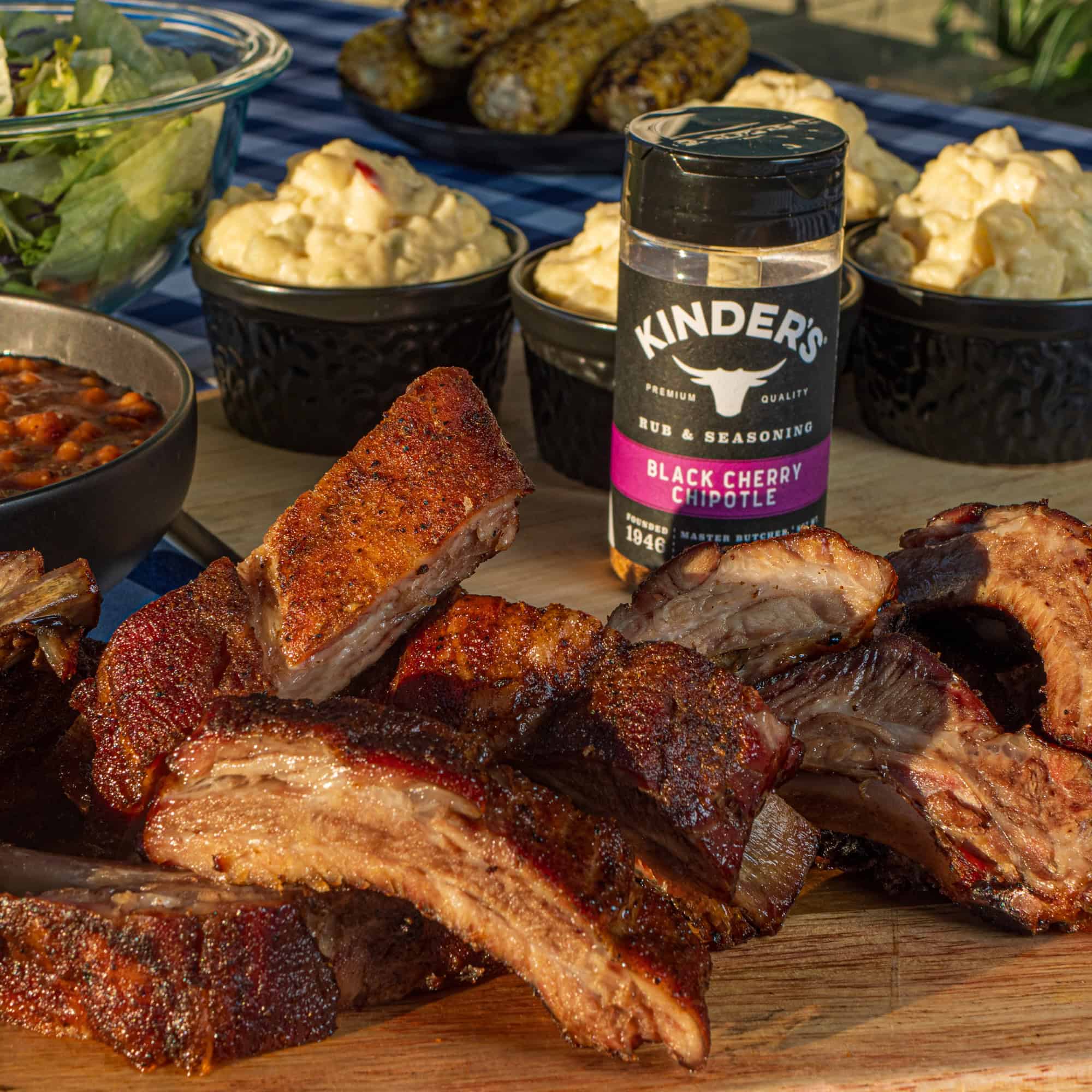
- Pat ribs completely dry with paper towels. If using a binder, lightly coat both sides with mustard or oil. Rub Kinder's Black Cherry Chipotle Seasoning all over—front, back, edges, everywhere. Go generous; this is your only layer of flavor. Let sit at room temperature 30 minutes (or refrigerate up to 4 hours if prepping ahead).
- Preheat smoker to 225–250°F. Use cherry wood for complementary fruity smoke, or cherry-hickory blend for complexity. Stabilize your temperature before loading ribs.
- Place ribs bone-side down on grates. Smoke unwrapped for the entire cook—no wrapping, no sauce. This is the key to maximum bark. Maintain steady temperature.
- Smoke time depends on temperature. At 225°F, expect 4.5–5 hours. At 250°F, expect 3.5–4 hours. Optional: After the first 2 hours, lightly spritz with apple juice every hour to keep the surface from drying out.
- Check doneness around hour 4 (or hour 3.5 if smoking hot). Ribs are ready when mahogany bark forms, meat pulls back ¼–½ inch from bones, the rack bends easily when you pick it up, or a meat probe slides between bones with almost no resistance. Internal temperature should reach 195–203°F.
- Remove from smoker, tent loosely with foil, and rest 15–20 minutes. This keeps the meat juicy and sets the bark.
- Slice between bones to serve as individual ribs or half-racks. The seasoning and smoke are all you need.
Nutrition
Notes
- No wrapping, no shortcuts — The bark is the whole point. Foil softens it. Leave the ribs in the smoke for the full cook and let the crust form on its own.
- Cherry wood locks in the flavor profile — It reinforces the fruit notes in Kinder's seasoning instead of competing with them. Cherry-hickory blend adds depth if you want more smoke presence without losing the fruit.
- Season heavier than you think — This is the only flavor layer. No sauce, no glaze. Go generous on the rub, covering front, back, and every edge.
- Use a probe, not a clock — Every smoker runs differently. Pull when the probe slides between bones with almost no resistance and internal temp hits 195–203°F.
- Rest before you slice — 15–20 minutes under loose foil sets the bark and redistributes the juices. Slice too early and the bark sheds, meat runs.
- Serve bare — just the ribs and the bark. A squeeze of lemon or lime works against the cherry-chipotle sweetness and brightens the whole plate without muting the smoke. Buttered cornbread and collard greens round out a Southern-style spread. Pickled onions or a vinegar-based coleslaw cut through the richness and add crunch where the bark leaves off.
- For a crowd, lay half-racks on a butcher block with lemon wedges and a stack of napkins. These don't need plating — the bark does that on its own.
- Cold smoked ribs straight from the fridge the next day are worth knowing about. The bark firms up overnight, slices clean, and the flavor is actually deeper.
- Store cooked ribs in an airtight container in the fridge for up to 4 days. Reheat on a foil-lined sheet pan at 300°F for 12–15 minutes, covered loosely — tight foil traps steam and softens the bark. Avoid high heat; it tightens the meat and you'll lose the texture you worked for.
- For longer storage, freeze individual portions unwrapped first, then transfer to a zip bag once solid. Thaw overnight in the fridge and reheat as directed. The bark won't be as crisp after freezing, but the smoke flavor holds.